Spotify's API Lock-Down: The End of Open Data for the Music Business?
By Apolline Reymond · February 18, 2026 · 5 min read
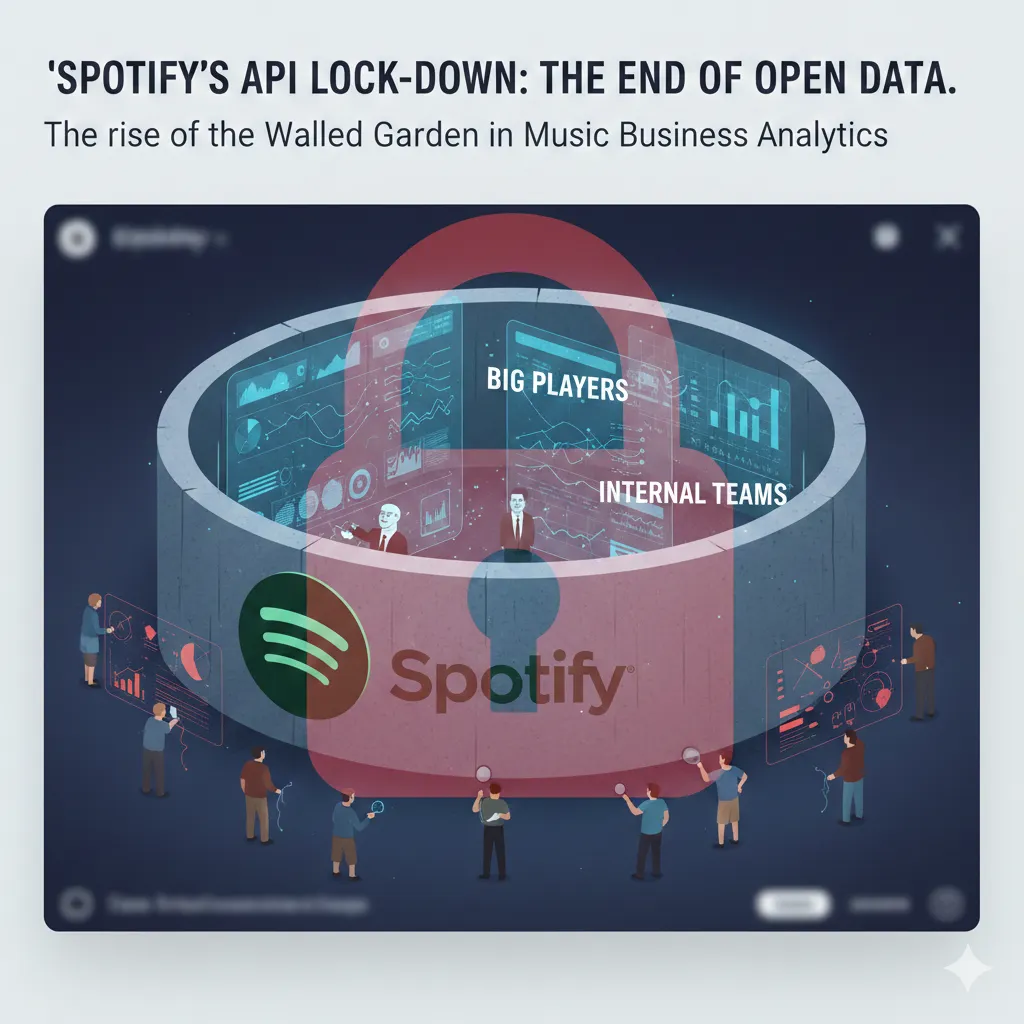
February 2026 brings major changes to Spotify's API. Between AI protection and strategic control, the platform just pulled the plug on key metadata essential for market auditing.
1. The Great Lockdown of 2026
For a decade, the Spotify Web API was the industry's "truth machine." If you wanted to build a tool to track whether a song was blowing up in Brazil, or a system to check if your ISRC codes matched your distributor's data, the API was your entry point. Thousands of startups built their entire value proposition on this "Open Data" window.
As of February 11, 2026, the sandbox is closed. Under the guise of "AI protection," Spotify has neutered its Development Mode. It's no longer just a quota limit — it's a systematic removal of the data points that made the API commercially viable for independent players.
2. From Open Audits to Restricted Access
The 2026 update creates a radical bifurcation of data access. In the new Development Mode, you are restricted to surface-level metadata, while "deep" industry data is hidden behind a manual approval wall.
To access professional data — like Top Tracks by country, Artist Popularity scores, or even just seeing the playlists of a competitor — you must now apply for Extended Quota Mode.
The Extended Quota Mode, or the "Chicken-and-Egg" Barrier
To apply for Extended Quota Mode, you must meet several criteria, including this one: be a registered business with a launched service and — most critically — a minimum of 250,000 Monthly Active Users (MAU). This creates an impossible paradox for startups:
- The Growth Ceiling: you cannot grow a product to 250k users when you don't have access to Extended Quota Mode, and you cannot get Extended Quota Mode if you don't have 250k MAU.
- The Approval Wall: even if you hit the numbers, access is no longer a right — it's a manual vetting process. Spotify now explicitly checks whether your tool "replicates" its internal B2B features. Build a dashboard better than Spotify for Artists, and you're now a competitor, not a developer.
The impact: for a startup at seed stage, or a data project, it is now commercially unviable to build a product that compares or audits the market without Spotify's explicit, manual approval.
3. The Asymmetry Strategy: Big Data for Big Players
Spotify isn't cutting off everyone — just the potential disruptors. Established data giants like Soundcharts and Chartmetric retain their access through legacy partnerships. But looking at the numbers, the "250k MAU" rule feels less like a metric of success and more like a selective filter.
The Audience Paradox
To put that 250,000 MAU requirement in perspective, let's look at the market leaders. Soundcharts, a reference for industry professionals, has an estimated monthly web traffic of around 130,000 visits (Similarweb, Jan 2026). Chartmetric, despite its massive database of 5M+ artists, operates in a B2B niche that likely doesn't hit the 250k "active users" mark every single month.
The Commercial Lock-In
If Spotify enforces a 250k MAU rule that even its top partners struggle to meet, it suggests two possible scenarios. First, a legacy "grandfather" clause: existing partners are likely grandfathered into old contracts — safe for now, but the last of their kind, since no new competitor will ever be allowed to reach their level. Second, the end of neutrality: by stripping ISRC and Popularity from the public API, Spotify has made these intermediaries more dependent than ever. They are no longer independent auditors — they are authorized resellers of Spotify's gated data.
In this new era, data partners aren't just allies; they are authorized resellers of a monopoly.
4. Why Now? (The AI Shadow & Internal Data Push)
Two major drivers explain this pivot.
The AI Firewall: Spotify is protecting its catalog metadata and playlist structures from being scraped for AI model training — following a major crackdown on unauthorized scraping in late 2025.
Consolidating the "Source of Truth": by limiting raw API access, Spotify ensures its own B2B platforms — Spotify for Artists and Campaign Kit (Marquee, Showcase) — as well as its chosen partners' platforms, remain the only certified sources for performance metrics.
5. What's Next? (Market Hypothesis)
Spotify's new restrictions appear less about data security and more about a calculated shift toward market dominance. Here is the likely strategy at play:
- Spotify as the sole insight provider: since 2025, Spotify has heavily invested in internal tools like SongDNA (mapping creative connections) and advanced audience segmentation. Cutting raw API access ensures its own platforms become the only source of truth for artist performance.
- Monetizing discovery: Spotify already monetizes algorithmic access via Discovery Mode. Restricting metadata that helps independent agencies target audiences implicitly pushes labels toward its own paid promotional tools like Marquee or Showcase.
- The "no replication" rule: if your audit tool even resembles what Spotify offers or plans to offer, Spotify now has a contractual right to cut you off.
- The "walled garden" effect: this mirrors the trajectory of platforms like Twitter (X) and Reddit — open APIs drive innovation first, then, once market dependency is established, APIs are restricted, forcing users back to proprietary interfaces.
6. Conclusion: How to Navigate the New Opacity
For music tech startups and professionals, this shift requires a new data strategy.
The critical need for multi-source matching: with the ISRC gone from the public Spotify API, manual or multi-platform cross-referencing (using YouTube or MusicBrainz) becomes a mandatory, if more complex, step for rights management.
Prioritize direct data feeds: since third-party API access is now fragile, relying on first-party data — direct distributor exports and official Spotify for Artists access — is no longer just best practice; it's the only stable foundation.
The "walled garden" reality: we are entering an era where major platforms (TikTok, Spotify, YouTube) will guard their metrics more fiercely. Data interoperability has taken a hit, making centralized audits a major challenge for the next generation of music tech.
Official Sources
- Web API Changelog — February 2026
- Update on Developer Access and Platform Security (February 6, 2026)
- February 2026 Migration Guide
- Updating the Criteria for Web API Extended Access (April 2025)
- Spotify Reports Fourth Quarter 2025 Earnings
- Spotify Quota Extended Conditions
This article is an analysis of Spotify's recent API restrictions and their impact on the music business ecosystem.