Music Data Blind Spots Are Costing Artists and Labels More Than They Think
By Apolline Reymond · May 15, 2026 · 4 min read
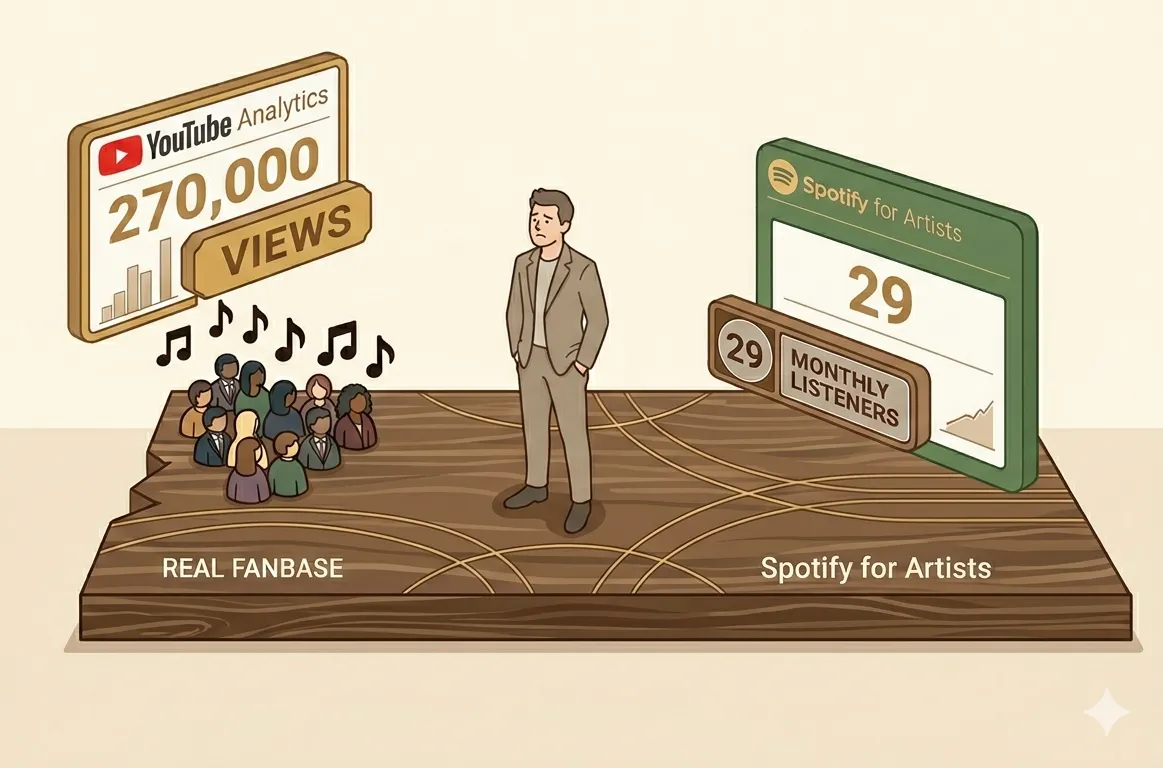
This artist isn't an isolated case: independent, years of work, and a real fanbase. Over 270,000 YouTube views in twelve months. And only 29 people are listening on Spotify every month. That ratio — 1 to 1,000 — isn't a quality problem. It isn't an effort problem. It's a visibility problem. And visibility, in 2026, is a data problem.
What we measure cross-source, and why
A cross-platform audit isn't about pulling numbers from a single dashboard. Every platform tells a partial story. YouTube Analytics tells you who watched. Spotify for Artists tells you who stayed. Neither tells you why the two audiences never met — or where the revenue is quietly leaking.
Our methodology systematically combines three sources: streaming analytics, audience geography, and platform signal quality. Signal quality is the part most teams miss. It's not just about streams — it's about whether the algorithm has enough correct, complete information about an artist to do its job. A missing bio, an incomplete profile, an absent Canvas — these aren't cosmetic. They're data gaps that tell the algorithm this artist isn't active. And the algorithm believes it.
The goal isn't to produce a report. It's to produce a roadmap — ranked by impact, actionable from day one.
What the data revealed
Three findings stood out in this audit.
The audience was built on paid traffic — not fans.
Over 90% of YouTube views came from advertising. An audience acquired through ads doesn't develop attachment. It doesn't search for the artist on other platforms. It doesn't save tracks on Spotify. When the budget pauses, the views stop — because the audience was never really there.
Subscriber counts and view totals look healthy. The underlying audience quality tells a different story.
The two platforms were speaking to completely different territories. YouTube audience concentrated in Singapore, the US, and China. Spotify listeners concentrated in Mexico and France. Zero geographic overlap. This isn't just a missed conversion opportunity — it's a signal that the growth strategy on each platform was built independently, with no shared logic. For a label managing multiple artists across multiple markets, this kind of misalignment compounds quietly, and expensively.
The algorithm had already started working. Nobody knew.
One recently released track showed a 67% save rate on Spotify — a signal strong enough to prompt consideration in Discover Weekly. The threshold is generally around 20%. It went unnoticed because no one was paying enough attention to Spotify for Artists, or correlating it with what was happening elsewhere. The machine was ready. The team wasn't.
Why does this matter?
Cross-platform analysis requires pulling data from multiple sources, aligning different metrics, and reading them together — a process that takes time, dedicated tools, and data expertise most teams don't have in-house.
Paid audience inflation, geographic misalignment, unread algorithmic signals — these aren't failures. They're blind spots that emerge naturally when teams are focused on creation and promotion, not data infrastructure.
For an artist with a manager and a small team, the cost is measured in missed streams and unconverted fans. For a label managing twenty artists across multiple territories, the cost compounds across every release, every campaign, every quarter. The algorithm has no ears. But it does read your data. And if that data is incomplete, misaligned, or simply unread — the best music in the world stays invisible.
What an audit delivers
Not a diagnosis. A direction. Within 48 hours: a clear picture of where audience is being lost, where revenue signals are going unread, and where three to five actions — executable immediately, without additional budget — would have the highest impact. The artists and labels who move fastest in the current market aren't necessarily the ones with the biggest budgets. They're the ones who know what their data is telling them.